
Your First pytest Suite
In short: a test is a function that calls your code and raises when the
answer is wrong — assert condition does nothing when it's true and raises
AssertionError when it's false, and that one rule is the whole idea. On your
own machine the tool that collects, runs and reports tests is pytest; it
has no pip and no terminal in this browser, so this lesson builds the part
that matters — collector, runner, report — in a few lines of plain Python,
and everything transfers. pytest.raises checks that code refuses bad
input; Python's own unittest and doctest do the same job with a different
shape, and both run right here.
Quarry has grown. It walks a yard of files, pulls fields out of log lines,
stores records in a vault and reports on them. Last week someone "tidied" the
log-line parser, every run still finished, and three days later the report
was quietly missing every WARN line. Nothing crashed, nothing warned — the
only way anyone could have known was to check. This section builds Quarry's
test rig, and this lesson writes its first tests.
Every lesson in this section tests the same small function. Quarry's log
lines look like WARN yard: disk 91% full — a level, a stage, a colon-space,
then free text:
The second line's message itself contains : , and partition splits only
at the first one, so the message survives intact. That is exactly the kind
of detail a later "tidy-up" breaks — and exactly what a test pins down.
Catch the regression that slipped through silently
assert is Python's one built-in test primitive:
The rule is strict, which is the point:
assert 0.1 + 0.2 == 0.3
print("passed")Watch out:
assertstatements are removed when Python runs with-O. That never matters for tests, but it's why you must never useassertto validate input in production — raise a real exception there, the wayparse_linedoes.
On your own machine you'd put tests like this in a file named test_*.py
and run pytest. No classes, no special assertion methods, no registration:
pytest collects every function starting test, runs each one
separately so one failure never stops the rest, and reports — rewriting
a failing assert before running it so you see the actual values, not
just False:
    def test_keeps_colons_in_message():
>       assert parse_line("INFO vault: a: b")["msg"] == "a:b"
E       AssertionError: assert 'a: b' == 'a:b'

test_parse.py:9: AssertionError
========== 1 failed, 1 passed in 0.02s ==========
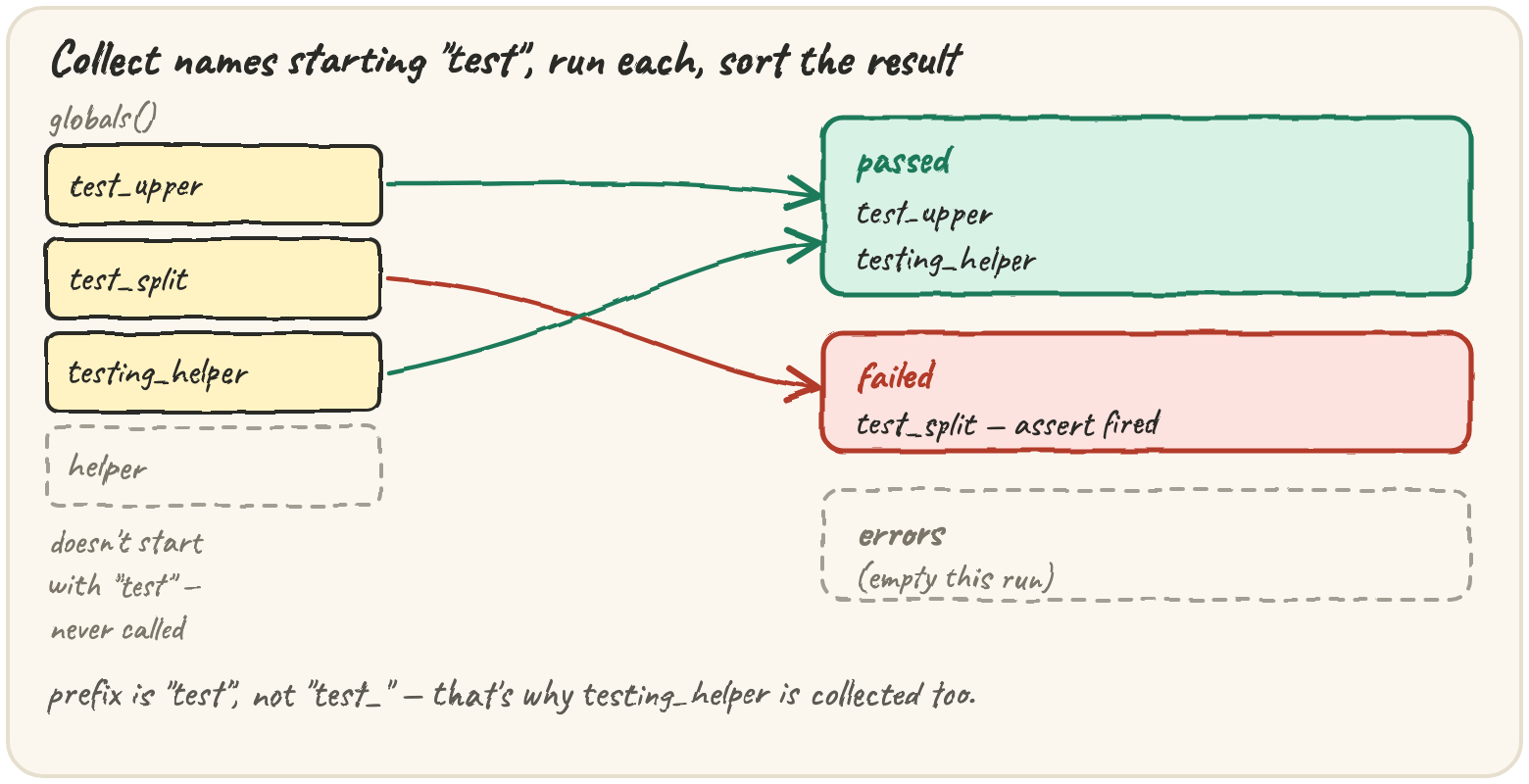
pytest does not run in this browser — no pip, no command line — so we
build the same three jobs by hand and grade the tests you write by calling
them. A module is, underneath, a dictionary from names to objects;
globals() hands you that dictionary, so collection is a filter over it:
testing_helper was collected — pytest's default rule is the prefix
test, not test_. And the report has three buckets, not two: a
failure means the code ran and gave the wrong answer; an error means
it never got that far, because something else raised first. The distinction
tells you where to look.
def test_lookup():
    levels = {"WARN": 2}
    assert levels["ERROR"] == 3

try:
    test_lookup()
    print("passed")
except AssertionError:
    print("failed")
except Exception as e:
print("error:", type(e).__name__)Prove a bad line really gets refused
Half of parse_line's job is saying no. pytest checks that with a context
manager — the with block passes only if the code inside raises that
exception (or a subclass), and fails if nothing is raised:
import pytest

def test_rejects_line_without_separator():
    with pytest.raises(ValueError):
        parse_line("no separator here")
That last sentence — the test fails if nothing is raised — is easy to lose when you write the check by hand:
This parse_line has a regression — it accepts junk. The test exists to catch exactly that, so it should report fail. It reports pass. Fix the TEST (not parse_line) so it cannot pass when nothing is raised.
A test that cannot fail is worse than no test — it turns green, and green is a promise. Every time you write one, make it fail once on purpose: break the code, or the expectation, and watch it go red.
Python's own unittest does the identical collect/run/report, just worded
differently — a method on a TestCase, self.assertEqual instead of
assert — and it does run here:
pytest runs unittest classes unchanged, so nothing written this way is
wasted. For small pure functions, doctest turns the docstring's own
example into the test, so documentation can't drift away from the code it
describes:
The next lesson, 05a, goes deeper into unittest and doctest, plus
tox — the tool that runs a whole suite across several Python versions.
Habits that make a suite worth having
One behaviour per test, named for it. Arrange, act, assert — build the
input, call the code once, check the result; a test needing three calls and
five asserts is probably three tests. Check the value a function returns,
never a printout. A bug becomes a test: the first thing you write when
Quarry misbehaves is the failing test that reproduces it, which then stays
forever — and if each test has some chance p of catching a particular bug,
n independent tests let it slip through with chance (1 − p)ⁿ. Ten vague
tests (p = 0.1) still miss a bug 35% of the time; a handful of sharp,
specific tests beats a pile of loose ones.
Quick practice
def test_div():
    assert 1 / 0 == 0

try:
    test_div()
    print("passed")
except AssertionError:
    print("failed")
except Exception as e:
print("error:", type(e).__name__)class Suite:
def test_inside_class(self):
assert True
def test_top_level():
assert True
def run_all(namespace):
report = {"passed": [], "failed": [], "errors": []}
for name, obj in list(namespace.items()):
if not (name.startswith("test") and callable(obj)):
continue
try:
obj()
report["passed"].append(name)
except AssertionError:
report["failed"].append(name)
except Exception:
report["errors"].append(name)
return report
print(run_all(globals())["passed"])def test_always_true():
result = parse_line("junk")
assert True
LEVELS = ("DEBUG", "INFO", "WARN", "ERROR")
def parse_line(line):
head, sep, msg = line.partition(": ")
if not sep:
raise ValueError("no separator")
return {"level": head, "stage": "", "msg": msg}
try:
test_always_true()
print("passed")
except Exception as e:
print("error:", type(e).__name__)🎯 Your turn
Build check_parse(cases) — the first piece of the test rig. Each case is a
pair [line, expected], where expected is either the dict parse_line
should return or the string "ValueError" when the line must be refused.
Run every case and return a report:
passed— how many cases behaved as expectedfailed— indices of cases that returned the wrong thing, or returned when they should have raisederrors— indices of cases that raised something nobody expected
check_parse([["WARN yard: disk full", {"level": "WARN", "stage": "yard", "msg": "disk full"}],
             ["junk", "ValueError"],
             ["INFO vault: ok", {"level": "INFO", "stage": "yard", "msg": "ok"}]])
# → {"passed": 2, "failed": [2], "errors": []}
parse_line is already in the starter. Run each case in its own try, so
one bad case can never stop the rest — that is the first thing every test
runner promises.