
Pickle, and Why You Must Not Load Untrusted Data
In short: pickle.dumps(obj) turns almost any Python object into bytes
and pickle.loads(data) rebuilds it exactly — tuples stay tuples, int keys
stay ints, datetimes and sets need no hooks, and shared references survive.
That's the opposite of JSON's lossy border crossing, and the price is steep:
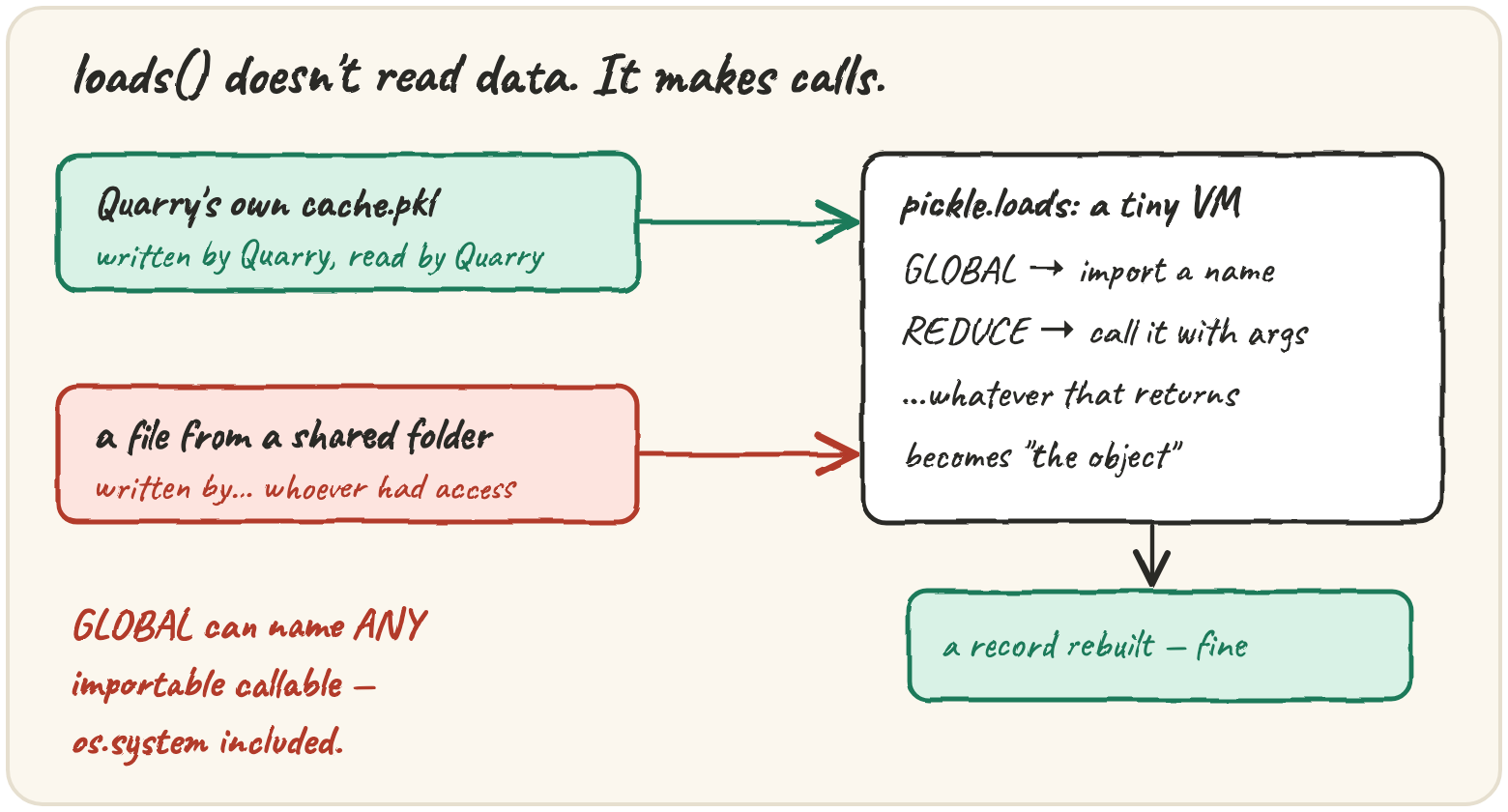
pickle.loads doesn't parse data, it runs a small program. The bytes
name a callable and arguments, and loading them calls that callable. If
the bytes came from anyone but you, they can name os.system as easily as
datetime. Pickle is for a program talking to itself — never for data
that crossed a trust boundary.
You'll build cache_batch(raws), the vault's batch cache: park a parsed
batch as bytes, and get back exactly the records you had.
Cache a parsed batch so tomorrow's run skips the parsing
Parsing is the slow part of Quarry's pipeline. If the source file hasn't changed, loading yesterday's parsed batch beats reparsing it:
back == record is True. The tuple is still a tuple, the int keys are
still ints — every lossy edge from the JSON lesson is gone. Pickle even
tracks which names point at the same object:
import pickle

shared = ["web"]
pair = [shared, shared]          # two references to ONE list
back = pickle.loads(pickle.dumps(pair))
back[0].append("disk")
print(back[1])What pickle can't carry is code: a function is pickled by reference — module and name — and reimported at load time. A lambda has no name to look up. A generator is a paused stack frame with nothing to name. Fix this batch so it pickles, keeping the rows intact:
Run it and read which object pickle refused. Then change the batch so it holds only data.
Open a batch cache written by someone you don't trust
Here's where the convenience turns dangerous. pickletools.dis shows what's
really in the bytes:
That's not a data layout — it's instructions for a tiny stack machine.
GLOBAL 'datetime date' imports datetime and pushes the date class.
REDUCE pops a callable and a tuple of arguments, calls the callable, and
pushes the result. Rebuilding a date means calling date(...) — and
that's exactly how pickle restores anything: by calling whatever the stream
names, with whatever arguments the stream supplies. A class controls its own
rebuild with __reduce__:
import pickle

class Sneaky:
    def __reduce__(self):
        return (str.upper, ("owned",))

blob = pickle.dumps(Sneaky())
print(pickle.loads(blob))str.upper is harmless; an attacker picks something that isn't. And the call
happens inside loads, before your code ever sees the result — no check
afterwards can help.
Here's that machine cut down to five instructions you can trace by hand:
Sign a cache so a tampered file is refused
Never unpickle data you did not produce yourself, from a place nobody else can write to.
A cache in a shared directory, an upload, a queue message: each is
"untrusted" the moment someone other than you could have written it. The real
fix is to not use pickle across a trust boundary at all — reach for JSON or a
database instead when data crosses between programs or people. When Quarry
writes its own cache and reads it back, signing proves the bytes are
yours: attach an HMAC, a keyed hash made with a secret only Quarry knows, and
check it before calling loads:
The comparison uses hmac.compare_digest, not ==, so the time it takes
doesn't leak how many bytes matched. A short checksum like CRC-16 is broken
almost at once; HMAC-SHA256's 256 bits put a forged tag out of reach. Signing
proves the bytes are yours — it does not make hostile bytes safe, which is
why the real rule is still "don't cross a trust boundary with pickle".
Quick practice
import pickle

print(pickle.loads(pickle.dumps((1, 2, 3))) == (1, 2, 3))TypeErrorRun it, read which object pickle refuses, then pickle a realised list instead of the generator and print "ok".
import pickle

class Payload:
    def __reduce__(self):
        return (len, ([1, 2, 3],))

print(pickle.loads(pickle.dumps(Payload())))🎯 Your turn
Write cache_batch(raws). The starter's build_record(raw) is the same
stand-in record stage as in the JSON lesson. Your function should:
- build
records = [build_record(r) for r in raws] - pickle the list to bytes with
pickle.HIGHEST_PROTOCOL, then load it back - return
{"count": len(restored), "intact": restored == records, "kinds": sorted type names of every value in every restored record}
Example: one incident record →
{"count": 1, "intact": True, "kinds": ["Decimal", "datetime", "int", "set", "str"]}.
Every one of those types came back as itself, which JSON couldn't do.
Hint: a set comprehension, {type(v).__name__ for r in restored for v in r.values()}, collects the names without duplicates. Then sorted it.
Press ▶ Run and hit ✓ Check. ✅