
async/await
In short: async/await is sugar over Promises, not a different
mechanism. An async function always returns a Promise. Inside it,
await somePromise pauses that function — not the whole program —
until the Promise settles, then hands back the resolved value, letting
asynchronous code read top to bottom like ordinary synchronous code. A
rejected awaited Promise becomes a thrown error, catchable with a
completely normal try/catch.
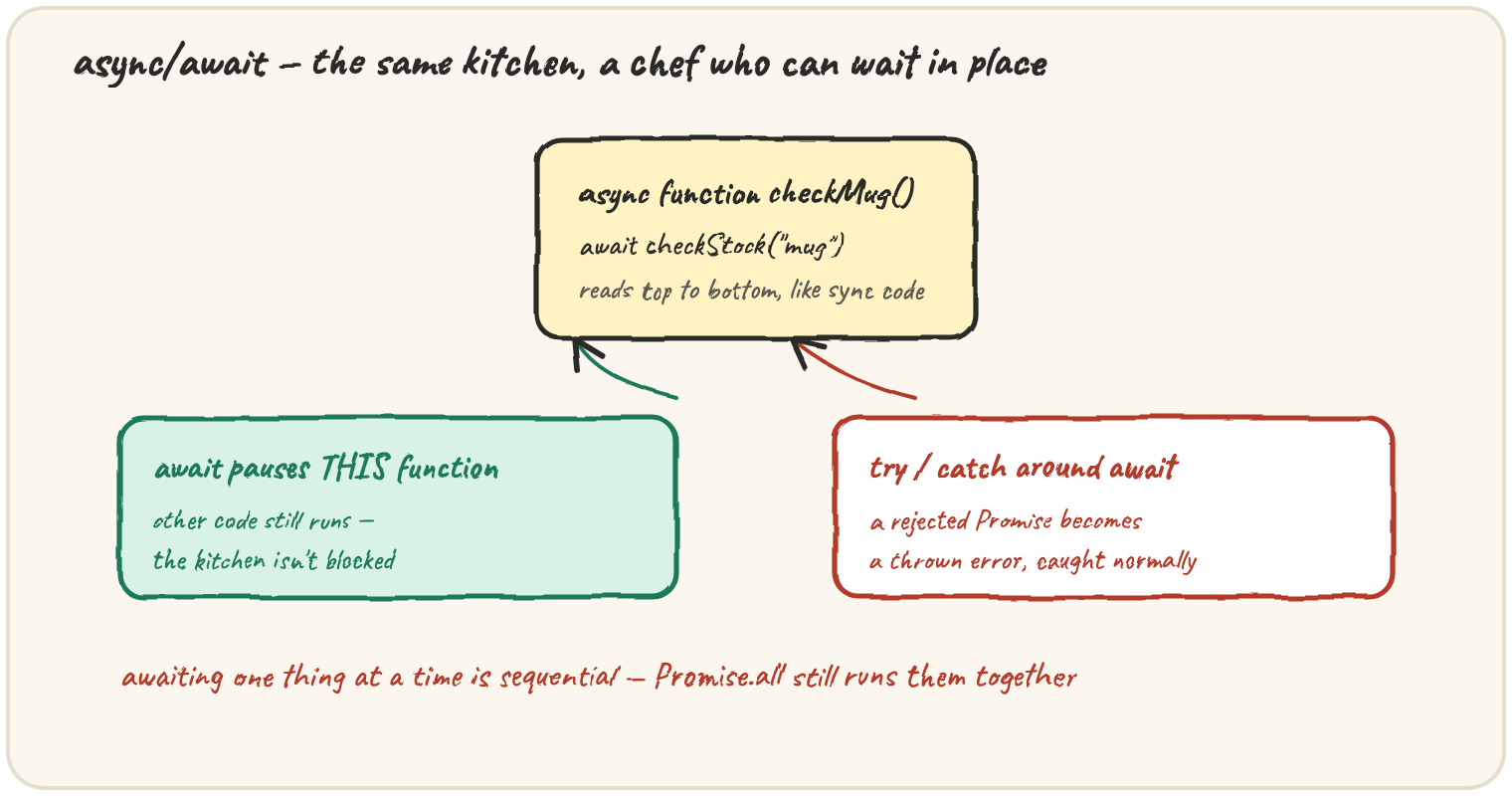
The same Promise, read top to bottom
Compare this with the .then() chain from the last lesson — same
operation, much flatter:
checkMug is an async function, so it returns a Promise automatically.
Inside it, await checkStock("mug") pauses right there until that Promise
resolves, then result holds the actual string — no .then() callback
needed. It reads exactly like synchronous code, even though it isn't.
Catching a rejection with ordinary try/catch
await turns a rejected Promise into something catch already knows how
to handle:
When checkStockStrict("sold-out-item") rejects, await re-throws that
rejection as a regular JavaScript error at the point of the await — the
surrounding try/catch catches it exactly the way it would catch a
throw. No .catch() method call needed; it's the same error handling
you already know.
Sequential awaits vs awaiting together
The trap: awaiting one thing at a time, when the steps don't actually depend on each other, makes independent work wait in line for no reason.
sequential doesn't start checking "notebook" until "mug" has fully
settled — two waits, back to back. concurrent starts both checks
immediately with Promise.all, so the total time is roughly one check's
worth, not two. Use sequential awaits only when a later step genuinely
needs an earlier result; otherwise, start independent work together.
Quick practice
What does an async function always return, even if it has no explicit return statement?
What does await somePromise do when that Promise is already rejected?
Why might await checkStock("mug"); await checkStock("notebook"); be slower overall than await Promise.all([checkStock("mug"), checkStock("notebook")]);?