
this Used Alone, and in Event Handlers
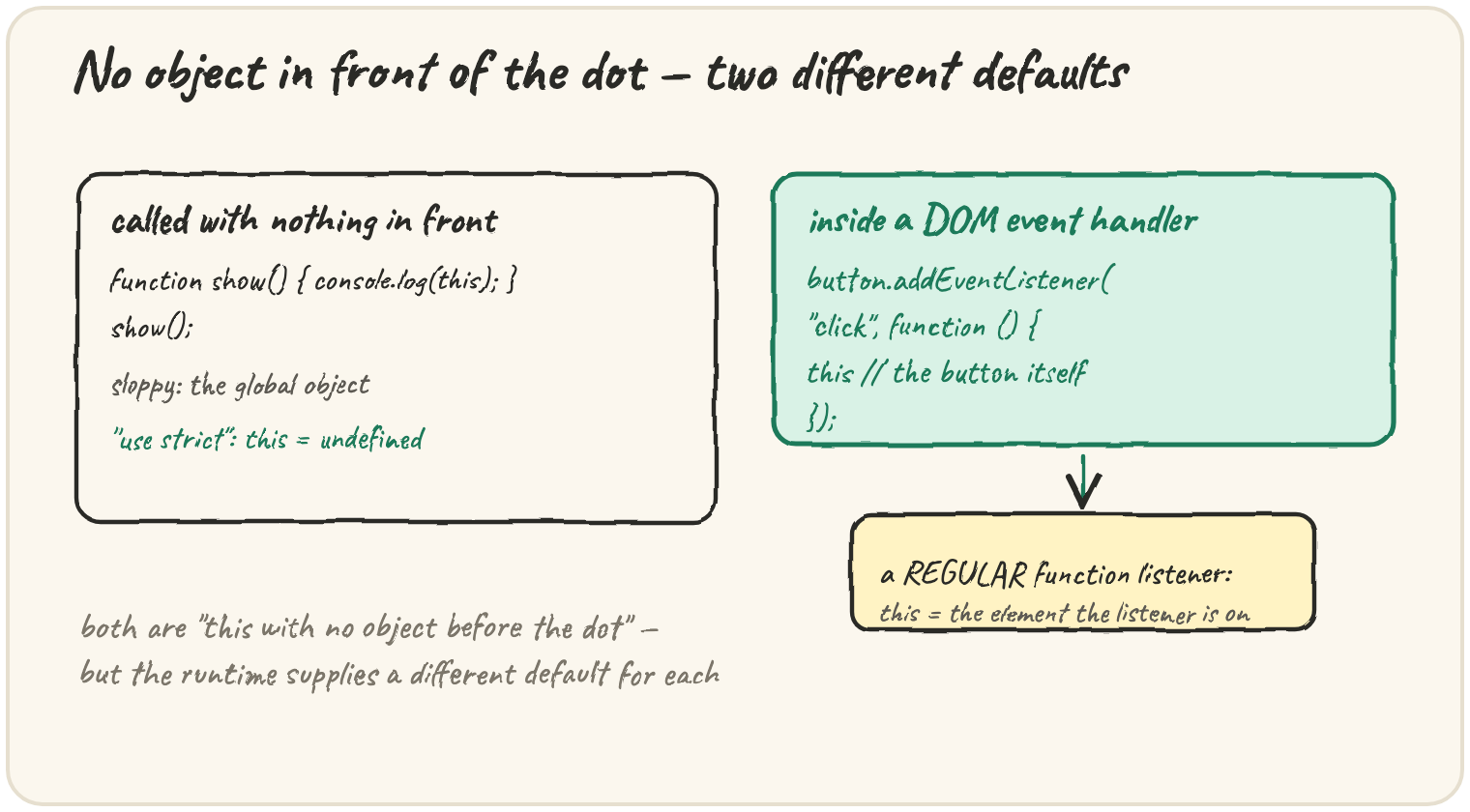
In short: call a plain function with nothing in front of the dot,
and JavaScript supplies a default this: the global object in sloppy
mode, or undefined in strict mode. DOM event listeners look like the
same situation — a function called with no object written before it — but
the browser deliberately overrides that default: inside a regular function
used as a listener, this is set to the element the listener was
attached to. Same shape of call, two different rules, because one is
JavaScript's ordinary default and the other is a DOM API making its own
choice.
Call a function with nothing in front of it
With no object before the dot, sloppy mode falls back to the global
object; strict mode refuses to guess and uses undefined instead:
This prints "object" — in sloppy mode (the default, no "use strict"
here), this defaults to the global object, which has typeof "object".
Add "use strict"; inside show, and the same call gives this = undefined instead — no silent fallback, just a clear "nothing was
supplied".
Read which element a click handler belongs to
DOM event listeners are a deliberate exception: even though a regular
function listener is "called" by the browser with no explicit object
before it, the DOM API sets this to the element itself — read this
code, it needs a real page to run:
const button = document.querySelector("#play");

button.addEventListener("click", function () {
  console.log(this); // the <button> element — set by addEventListener, not by JavaScript's own default
  this.disabled = true; // this really is the button — can set its properties directly
});
this here is the exact <button> the listener is attached to, letting
the handler act on it directly — this.disabled = true disables the
button that was just clicked, with no need to look it up separately.
The trap: expecting the same default everywhere
Seeing this used with no explicit object in front of a call doesn't tell
you which rule applies — plain JavaScript's default (global object or
undefined) and a DOM API's own special-cased this (the listening
element) look identical at the call site. What decides it is who is
doing the calling: your own code calling a plain function follows
JavaScript's rule; addEventListener calling your listener follows the
DOM's rule.
Quick practice
What does function show() { console.log(typeof this); } show(); print, with no strict mode?
What is this inside function show() { "use strict"; console.log(this); } show();?
Inside a regular function used as button.addEventListener("click", function () { ... }), what is this?
Why does a DOM event listener's this differ from a plain standalone function call's this?
What can this.disabled = true; do inside a click listener on a button?
🎯 Your turn
A button has
button.addEventListener("click", function () { console.log(this); });
attached with a regular function. Explain what this is inside that
function when the button is clicked, and how it's different from calling
a plain standalone function with no object in front of it.
Write your explanation and submit it — there's no code to run here, just your reasoning.