
this in Arrow Functions
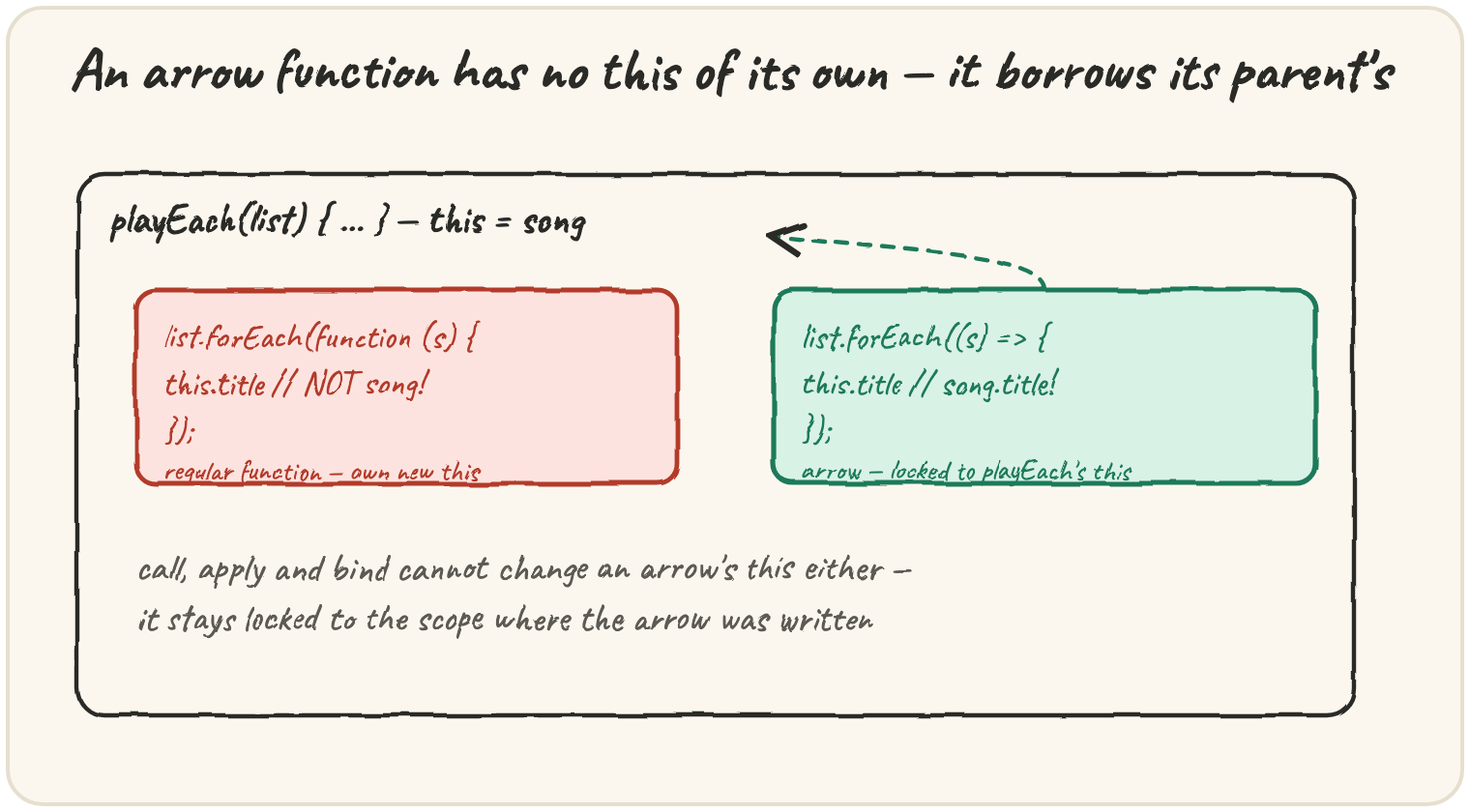
In short: an arrow function has no this of its own. Wherever you
write this inside an arrow, it looks outward to the this of the scope
the arrow was written in — fixed at that point, permanently. This
makes arrows the natural fix for a callback that needs its enclosing
method's this: a regular function callback gets its own fresh this
(usually not what you want), but an arrow simply keeps using the this
that was already in scope around it.
Keep this working inside forEach
A regular function passed to forEach is called as a plain function, so
it gets its own this — not the enclosing method's. An arrow function in
the same spot keeps the method's this:
The regular function's this is undefined (strict mode, called
standalone by forEach), so this && this.title short-circuits to
undefined. The arrow function never asks "what was I called with?" — it
simply uses playEach's own this, which is song, so it logs
"Blue Hour".
Confirm the arrow's this never changes
Because an arrow's this is fixed at the point it was written, not at
the point it's called, even call, apply and bind — which exist
specifically to set this — have no effect on it:
All three lines print "Blue Hour". arrow was created inside make(),
where this was outer — that's locked in forever. .call(other) and
.bind(other) try to supply other as this, but an arrow function
never reads a this from how it's called in the first place, so there is
nothing for them to override.
The trap: an arrow as an object's own method
Because an arrow's this comes from its surrounding scope, writing one
directly as an object's method usually backfires — at the point the
object literal is written, this isn't the object being built yet:
This logs undefined — play's this is whatever this was in the
surrounding code where the object literal itself was written, never
song. (The this && guard just avoids crashing if that surrounding
this happens to be undefined — its value depends on where the object
literal sits, which is exactly the point: it's not song.) Use a
regular method (play() { ... }) for an object's own methods; save arrows
for callbacks inside a method, where borrowing the method's this is
exactly what you want.
Quick practice
What this does an arrow function use, when this appears inside it?
Inside a method, list.forEach(function (s) { this.title }) vs list.forEach((s) => { this.title }) — which keeps the method's this?
Can .call() or .bind() change what this an arrow function uses?
Why is writing an arrow function directly as an object's method usually a mistake?
When is an arrow function the right tool for this-handling?
🎯 Your turn
Explain why list.forEach(function (s) { console.log(this.title); })
inside a method loses this, while
list.forEach((s) => { console.log(this.title); }) in the exact same spot
does not, and why call/apply/bind cannot change an arrow function's
this.
Write your explanation and submit it — there's no code to run here, just your reasoning.