
The for...of Loop
In short: for (const value of iterable) hands you each value
directly, one at a time, with no index and no counting. It works on any
iterable — arrays, strings, Maps, Sets — because each of those defines
how to hand out its items in order. It does not work on a plain
object, which has no built-in order to iterate, and throws a TypeError
if you try.
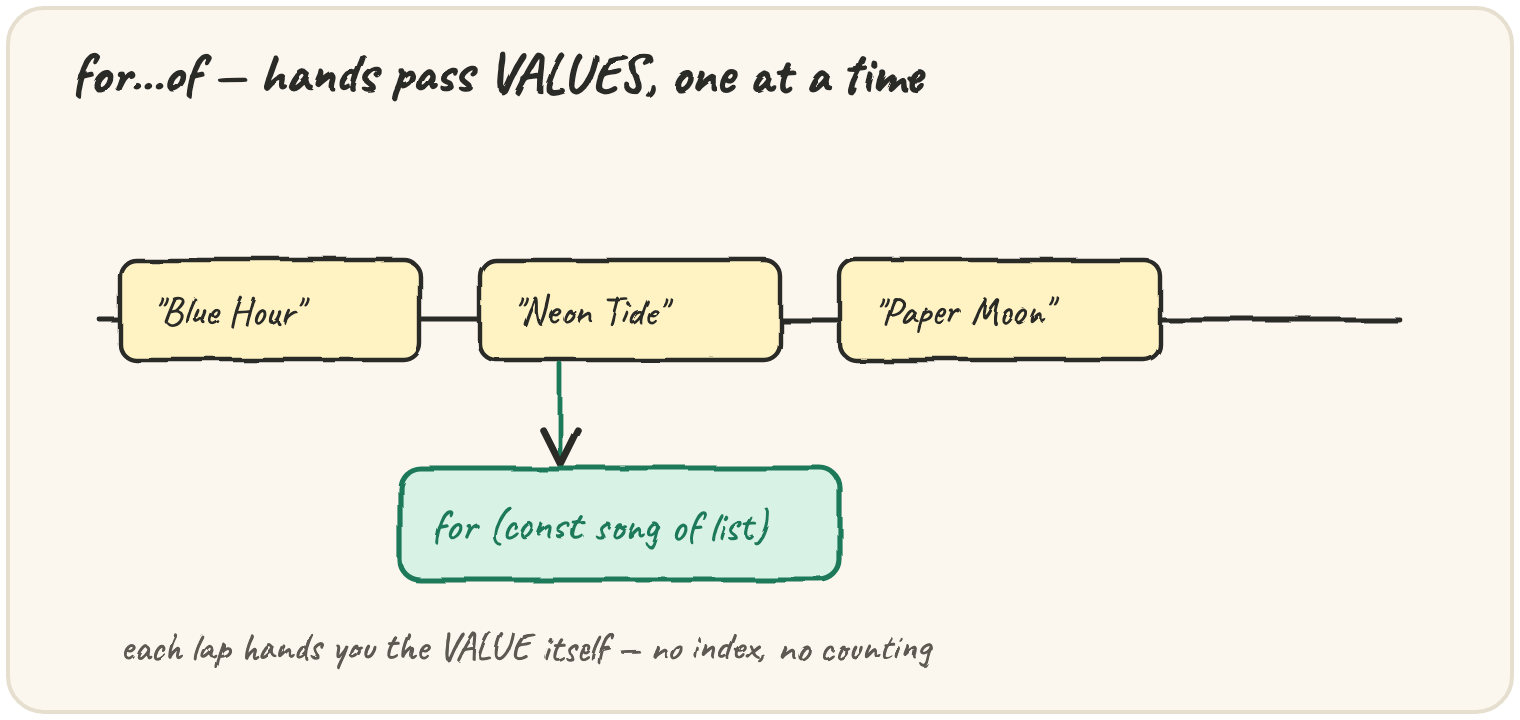
Printing every song, no counting required
When you don't need the position, for...of is the cleanest way to visit
every item:
Compare this with a for loop that needs songs[i] and an index variable
you never actually use — for...of hands you the song directly.
Walking a string, and a Map's entries
for...of isn't just for arrays — it works on anything iterable:
A string hands out one character per lap. A Map hands out [key, value]
pairs, which the loop destructures straight into title and count —
no .get() calls needed.
The object that isn't iterable
The trap: a plain object looks like it should work, but doesn't.
Arrays, strings, Maps and Sets all define an iterator — a built-in way
to hand out their contents in order. A plain object doesn't, so
for...of has nothing to walk and throws a TypeError. To loop over an
object's own properties, use for...in (next lesson) or
Object.entries(song), which turns it into an iterable array of pairs.
Quick practice
What does for (const x of [10, 20, 30]) { console.log(x); } print?
What does for (const ch of "Go") { console.log(ch); } print?
What happens when for...of runs on a plain object like { a: 1 }?