
Arrow Functions
In short: (params) => expression is a slimmer way to write a
function — but it's not just shorthand. An arrow function has no this
and no arguments of its own; both are borrowed from the surrounding
scope where the arrow was written. That makes arrows the right choice
inside a callback that needs the outer this, and the wrong choice for an
object method or a constructor.
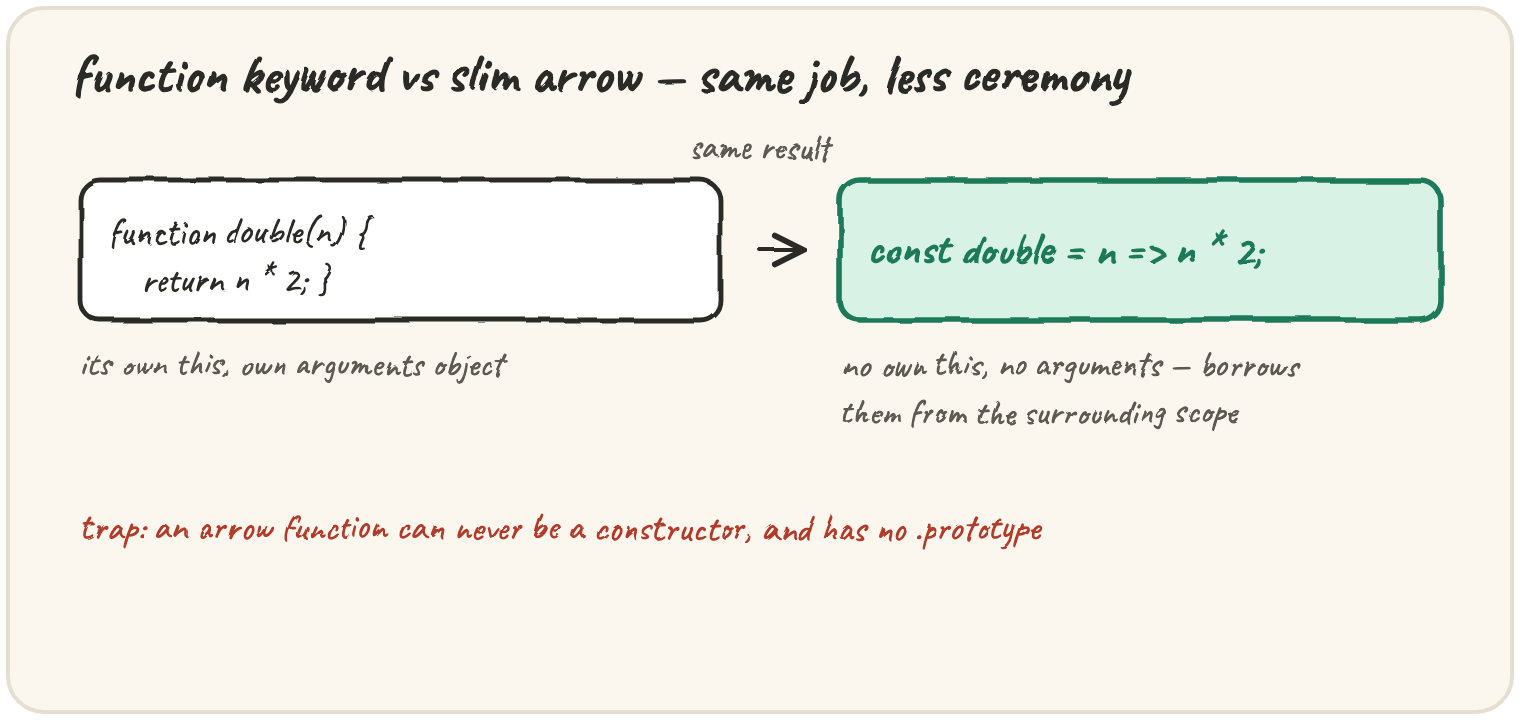
The same function, written two ways
For a plain calculation with no this involved, the two are
interchangeable:
Both give 10. The arrow drops function and return entirely when the
body is a single expression — pure convenience, nothing else changes yet.
Fixing this inside a callback
The real reason arrows exist: a regular function passed to setTimeout
gets its own this, which is not the object you meant.
Because the arrow has no this of its own, this inside it means exactly
what it meant one line above, in incArrow — counter. A regular
function passed to setTimeout instead would get a this decided by
how setTimeout calls it, not by where it was written — almost never
what you want.
Borrowing arguments too
Arrows don't just skip their own this — they skip their own arguments
object as well, and see the enclosing function's instead:
inner is an arrow, so arguments inside it isn't its own — it reaches
out to regularOuter's arguments, which has length 3. An arrow
function genuinely has no arguments binding of its own to shadow it.
Quick practice
What does an arrow function use for this inside its body?
Why is a regular function passed to setTimeout often the wrong choice inside an object method?
What happens when you try new SomeArrow() on an arrow function?