
Conversion vs Coercion
In short: JavaScript changes a value's type constantly — sometimes
because you asked, sometimes because it decided to. Type conversion
(explicit casting) is a change you write yourself by calling a function
named after the target type: Number(x), String(x), Boolean(x). Type
coercion (implicit casting) is a change the engine makes on its own,
because an operator or a statement needed a different type than you gave
it. Every conversion, whichever way it happens, lands on one of exactly
three targets: string, number, boolean.
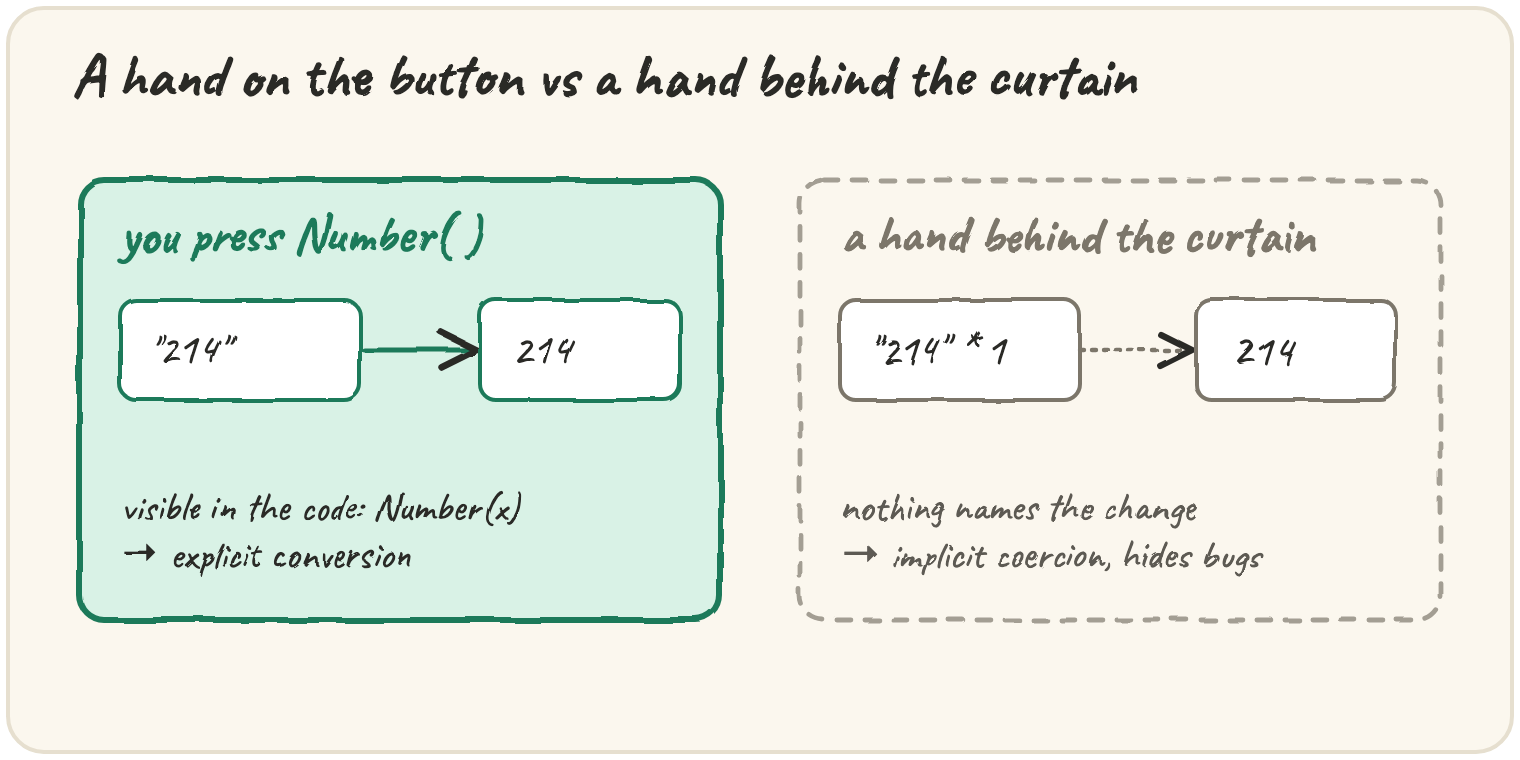
Reading a form length on purpose
The clearest kind of type change: you name the type and call it.
Number(typed) is explicit conversion — the code says, right there, "turn
this into a number." Nothing about the result is a surprise, because the
change is written on the line.
The same change, hidden inside an operator
Now the same string meets an operator without anyone calling a conversion function:
"214" * 1 needs numbers on both sides, so the engine coerces the string
to 214 — same result as Number(), but nothing in the code names it.
"Plays: " + 3 coerces the number 3 into text instead, because + sees
a string on one side. And if (...) always needs a boolean, so it coerces
whatever you give it using the truthy/falsy rules. Three different targets,
same silent mechanism.
Spotting both in one line
Real expressions often mix explicit and implicit changes in the same statement, and the hidden half decides the answer:
Number("214") is explicit — you can point at it. The division then has
two numbers, so nothing changes there. But "Length: " + minutes coerces
minutes into text, silently, because it meets a string at +. Read every
expression left to right and ask at each operator: "was a type named here,
or did two different types just collide?"
The line
const label = "Length: " + minutes;withminutesequal toNumber("214") / 60.
Quick practice
Number("42") is an example of what?
"42" * 1 is an example of what?
In if ("hello") { ... }, what happens to the string?
What does String(214) + 1 give?