
BigInt and Symbol
In short: two primitive types exist for problems the other five can't
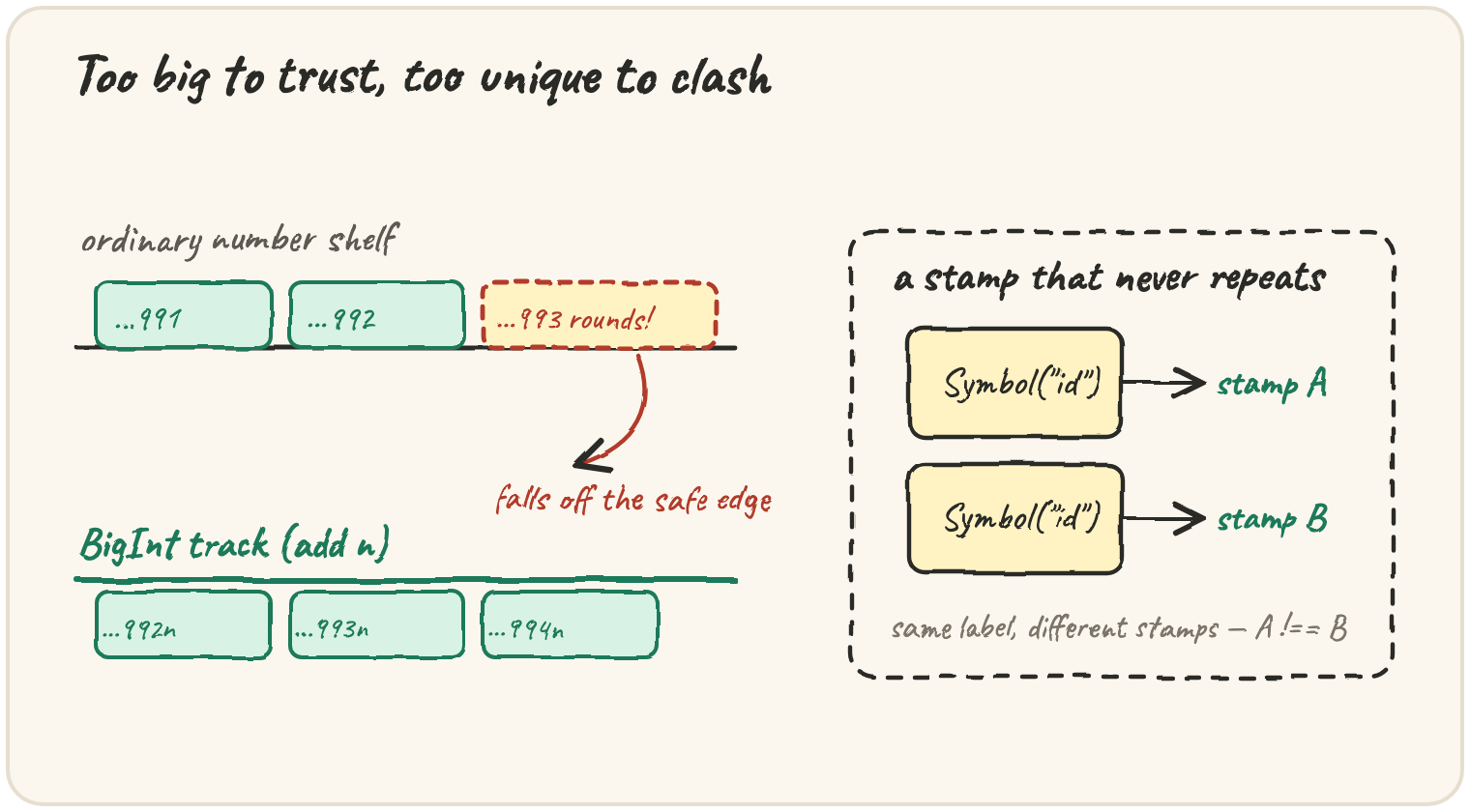
solve. Number.MAX_SAFE_INTEGER (9007199254740991) is the largest whole
number an ordinary number keeps exact — past it, results quietly round.
BigInt (a trailing n) stores any whole number exactly, but never mixes
with a plain number in arithmetic. Symbol creates a value that is
guaranteed unique, even against another symbol with the identical
description — useful for object keys that must never clash.
A stream counter that stops climbing
A hit song's total stream count can pass nine quadrillion. An ordinary number can't hold every value that large exactly:
Adding 1 does nothing — the true result needs more precision than a 64-bit float has, so it rounds right back to where it started. The counter looks frozen, and nothing in the code raised an error to tell you.
Switching that counter to BigInt
Add a trailing n and the same counter becomes exact at any size:
9007199254740992n + 1n gives the correct 9007199254740993n. Division
rounds toward zero because BigInt only holds whole numbers — 7n / 2n is
3n, never 3.5n.
The catch: BigInt and ordinary number can never appear on the same side of an arithmetic operator.
Mixing them throws a TypeError. To combine with a normal number, convert
it on purpose: bigStreams + BigInt(1).
Try an ordinary number
9007199254740992 + 1should be ...993, but it gives 9007199254740992: past the safe limit, the result rounds.
Tagging an object without a name clash
A logging library wants to attach a hidden id to any object you pass it,
without ever overwriting a property you already named id:
Every Symbol() call makes a brand-new value — the text "id" is only a
debugging label, not part of its identity, so id1 === id2 is false. A
symbol key can only be reached by someone holding that exact symbol, and it
is skipped by JSON.stringify and for...in, so it never collides with an
ordinary property name.
Quick practice
What is typeof 10n?
What happens when 5n + 2 runs?
What is 9n / 2n?
What does Symbol("key") === Symbol("key") evaluate to?