
Bridges & Articulation Points
In short: a bridge is a road whose closure splits the network, and both come
out of one DFS and one number per junction, the low-link — the smallest
discovery number reachable from a junction's subtree by one back road. A tree road
parent–child is a bridge exactly when low[child] > disc[parent]: nothing below
child can climb back to parent or above. Junctions use the same idea with
>= instead of >, since a back road landing exactly on a junction doesn't help
once that junction itself is gone.
Roads close. A burst water main, a parade, a resurfacing crew: every week some of Meridian's roads are shut for a day. Usually the vans just go another way. But the road from the mill up to the north side is the only way up there, and the day it closed, three depots' worth of parcels sat undelivered while the planners worked out what had happened.
This lesson finds those roads ahead of time. A road whose closure disconnects the network is a bridge. A junction whose closure disconnects it is an articulation point, also called a cut vertex. Both come from one depth-first search and one number per junction, the low-link.
The obvious way, and why it's slow
The definition gives an algorithm straight away: close each road in turn and check whether the network is still in one piece.
roads = [("a", "b"), ("b", "c"), ("c", "a"), ("c", "d"), ("d", "e")]

def pieces(kept):
    parent = {j: j for j in "abcde"}
    def find(x):
        while parent[x] != x:
            x = parent[x]
        return x
    for a, b in kept:
        parent[find(a)] = find(b)
    return len({find(j) for j in parent})

print(sum(pieces([r for r in roads if r != cut]) > 1 for cut in roads))It's correct, but every closure means a full pass over the network: O(E × (V + E)). Street networks have about 1.5 roads per junction, so for n junctions one connectivity check costs about 2.5n steps, and closing every road in turn about 3.75n². That passes ten million steps at about 1,600 junctions, which is a small town. A real city has hundreds of thousands, where closing each road costs hundreds of billions of steps. The low-link method below does it in one pass of about 2.5n.
A back road is a way round
Run DFS over the two-way roads. The roads it travels along to discover new junctions form the DFS tree. Every other road is a back road, and in an undirected DFS a back road always joins a junction to one of its own ancestors in the tree. There are no "cross" roads between separate branches, because DFS would have taken such a road to discover the other branch.
A back road is a way round. If some junction below a tree road has a back road
climbing above that tree road, the tree road can close and traffic can use the
back road instead. So a tree road parent–child is a bridge exactly when nothing
in the child's subtree has a back road climbing to the parent or higher.
Discovery numbers and low-links
To make "climbs to the parent or higher" something you can compute, number the junctions 0, 1, 2… in the order DFS discovers them. Ancestors always have smaller numbers. Then give each junction a low-link:
low[j]= the smallest discovery number reachable fromj's subtree by going down tree roads and then taking one back road (never the tree road straight back to its parent).
Two updates build it:
- a back road from
jto an earlier junctiona:low[j] = min(low[j], disc[a]); - a child
cfinishing:low[j] = min(low[j], low[c]), because whateverccan climb to,jcan too.
And the bridge test is one comparison:
Tree road
parent–childis a bridge whenlow[child] > disc[parent].
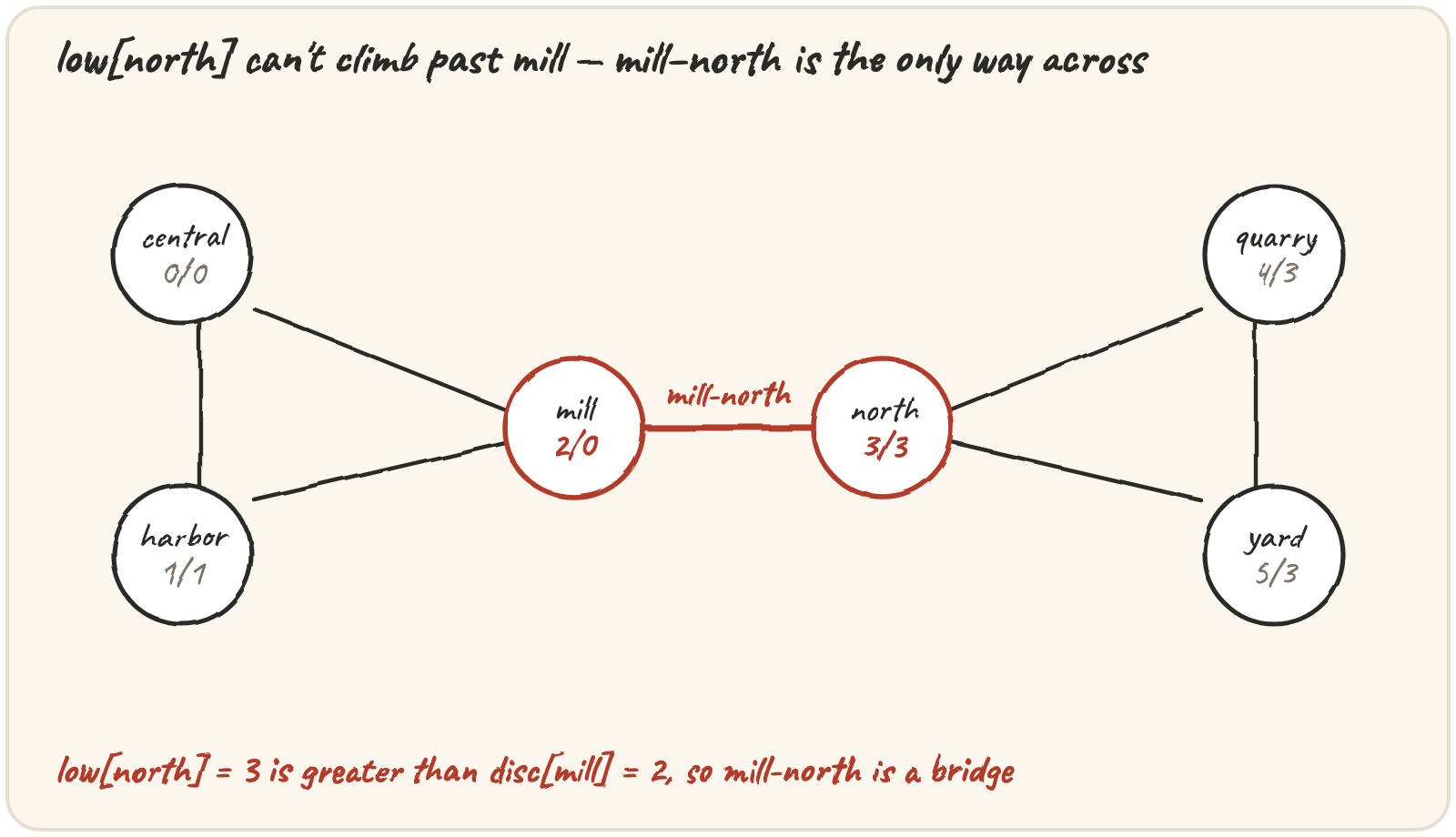
Watch it on six junctions: two triangles joined by the road from mill to north. Tree
roads are marked done, back roads compared, and badges read disc/low:
A tree road is a bridge when nothing below it has a back road climbing past it. The low-links carry that fact up the tree.
DFS starts at central and gives it discovery number 0. 6 nodes, 7 edges, undirected. At central. central: 0/0.
The code
Iterative again, with a stack of (junction, parent, roads left). The one subtle
line is skipping the parent. The road you arrived on shows up in your own
neighbour list, and treating it as a back road would make every low-link climb to
its parent, so nothing would ever look like a bridge.
One DFS, constant work per road: O(V + E). Space is O(V + E) too: near
holds every road twice (once from each end), and disc, low and the stack hold
at most one entry per junction.
Trace the low-links on a triangle with a tail:
Greater than, or greater-or-equal?
The bridge test is strict. If the child's subtree can climb exactly to the
parent, the back road lands on the parent itself, which is a way round the tree
road. This version uses >=, and gets it wrong:
Only the tail road c to d is a bridge, but this also reports a to b, which sits on the triangle. Fix the comparison.
>= isn't useless, though. It's the right test for junctions.
Articulation points: the junctions you can't close
Closing a junction closes every road into it. A non-root junction p is an
articulation point when some DFS child c has
low[c] >= disc[p]:c's subtree can climb topbut not above it, so withoutpit's stranded.
That's >= because a back road landing on p doesn't help once p itself is gone.
The DFS root needs its own rule, since there's nothing above it: it's critical
exactly when it has two or more DFS children. Critical junctions and critical
roads are different things:
roads = [("a", "b"), ("b", "c"), ("c", "a"), ("c", "d"), ("d", "e"), ("e", "c")]

def pieces(junctions, kept):
    parent = {j: j for j in junctions}
    def find(x):
        while parent[x] != x:
            x = parent[x]
        return x
    for a, b in kept:
        parent[find(a)] = find(b)
    return len({find(j) for j in junctions})

print(pieces("abde", [r for r in roads if "c" not in r]))A bridge's endpoints are usually articulation points. The exception is an endpoint with no other roads, like the last house on a dead-end street.
Your turn to drive it
Here's the low-link DFS on the six junctions, badging disc/low and turning every
bridge red. Add the road ["harbor", "north"] and run it again. The bridge
disappears, because the north side now has a way round.
Your low-link DFS. Badges read disc/low, and a road turns red when nothing below it can climb past it.
❓ Cross-question: "Does it matter where DFS starts?" Not for the answer. Discovery numbers and low-links change with the starting junction and the neighbour order, but the set of bridges and articulation points is a property of the network itself. What changes is only which junction is the root and needs the special rule.
Idioms & real-world patterns
Where this matters
Network engineers look for bridges and cut vertices to find single points of failure: the one cable, router or substation whose loss splits the network. Power grids, water mains, supply chains and road maps are audited the same way. Adding a single link that creates a way round removes the bridge, and the capstone of this section prices exactly that.
Two-edge-connected pieces
Delete every bridge and what's left falls into two-edge-connected components: groups that survive any single road closure. Shrink each group to a point and the bridges join them into a tree, the bridge tree. It's the undirected cousin of the condensation from the last lesson.
⚡ Advanced: one-way streets without stranding anyone
Robbins' theorem: a connected road network can have every road made one-way so that everyone can still reach everyone exactly when it has no bridges. A bridge made one-way strands one side, and without bridges, DFS gives an orientation that works: tree roads point down, back roads point up. The capstone's boss exercise builds it.
Quick practice
near = {"a": ["b", "d", "e"], "b": ["a", "c"], "c": ["b", "d"], "d": ["c", "a"], "e": ["a"]}
disc, low, found = {}, {}, []

def dfs(v, parent):
    disc[v] = low[v] = len(disc)
    for w in near[v]:
        if w == parent:
            continue
        if w in disc:
            low[v] = min(low[v], disc[w])
        else:
            dfs(w, v)
            low[v] = min(low[v], low[w])
            if low[w] > disc[v]:
                found.append((v, w))

dfs("a", None)
print(found)c is the shared junction between two triangles, so closing it splits the network, but this prints []. Fix the comparison.
🎯 Your turn
Write critical_roads(junctions, roads). Return every road whose closure would
disconnect junctions that were connected, as [a, b] with a before b
alphabetically, the list sorted:
critical_roads(["a", "b", "c", "d"], [["a", "b"], ["b", "c"], ["c", "a"], ["c", "d"]])→[["c", "d"]]- a ring of four roads →
[]
Hint: DFS with discovery numbers and low-links; a tree road is critical when
low[child] > disc[parent]. Don't forget junctions in a separate piece of the
network.
Then press ▶ Run, tap the Live App try chips to call it with different inputs, and hit ✓ Check. Green = this piece of Meridian is built. ✅