
Aho-Corasick: Matching Many Patterns at Once
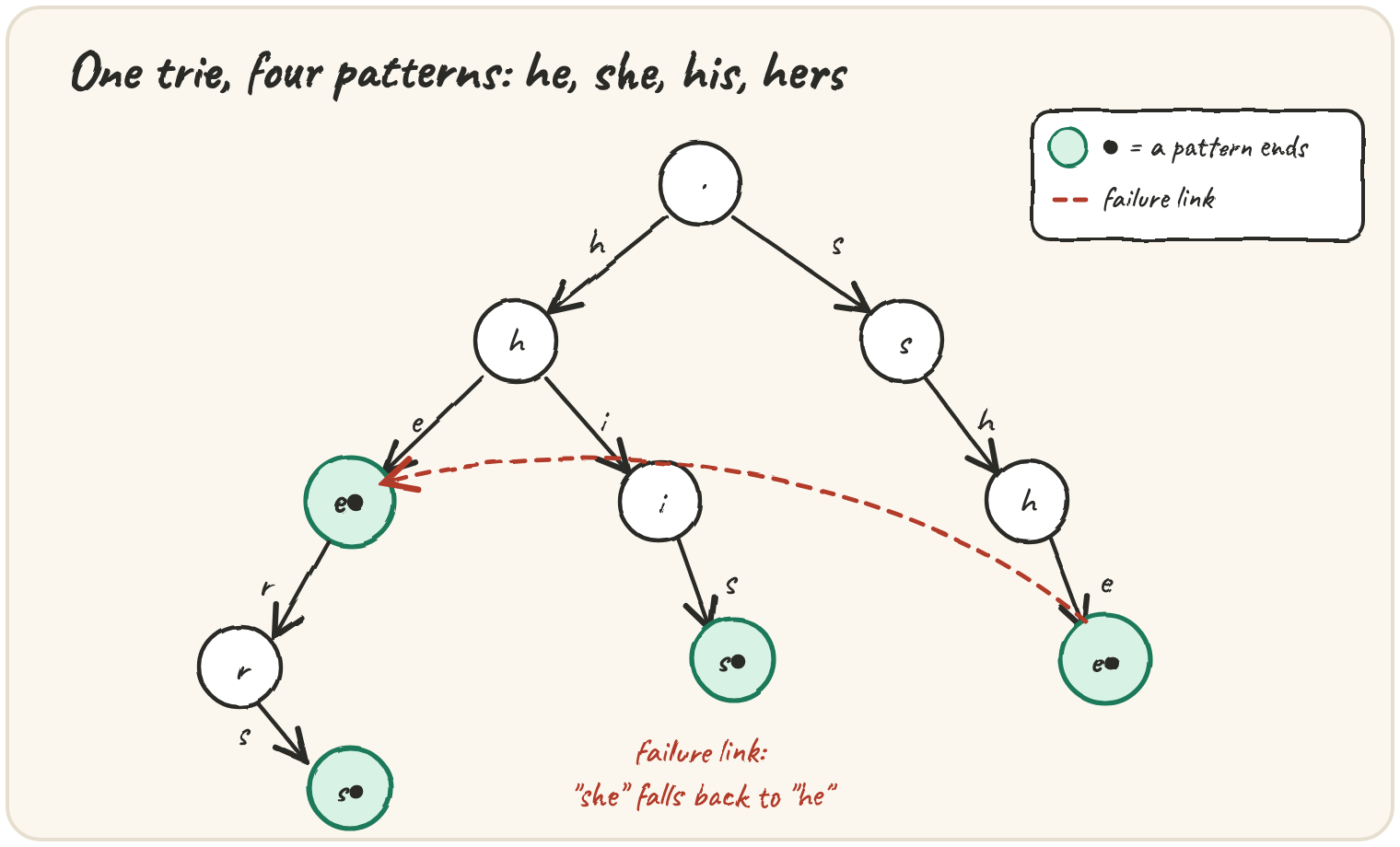
In short: KMP finds one pattern in one text pass. Aho-Corasick finds every pattern in a whole dictionary in one text pass. Build a trie (section 4's structure) of all the patterns, then give every node a failure link — "if matching breaks here, where in the trie should I carry on from?" — the same idea as KMP's border, generalised from one string to a whole tree of them. The text pointer still never moves backwards; only the trie pointer jumps.
Scanning a document for every banned word at once
A moderation filter checks a post against a list of a thousand banned
phrases. Calling .find() once per phrase means reading the post a
thousand times — O(n · k) for k phrases. A trie merges the phrases that
share a prefix, so the text is only ever read once, no matter how many
phrases there are.
This gives the right answer, but it scans "ushers" four separate times.
Aho-Corasick reads it once and finds all four matches (or, here, the three
that actually occur) as it goes.
Building the trie, then the failure links
The trie part is exactly lesson 4's: insert every pattern character by character, sharing prefixes. Aho-Corasick adds a second pass over the trie, breadth-first, giving every node a failure link — the node you'd be at if you'd started matching from the next possible alignment instead. It is built the same way KMP's failure function is: a node's failure link follows its parent's failure link, extended by the same character, climbing until a match is found or the root is reached.
output[v] |= output[fail[v]] is the detail that's easy to miss: if "he"
ends at a node, and a longer pattern's failure link lands there, "he" has
to be reported too — a match doesn't stop being a match just because a
longer pattern also matched at the same spot.
Walking the text once
The scan looks exactly like KMP's, except "no match, follow the failure
link" now jumps between trie nodes instead of positions in one pattern,
and every node's output set can report more than one pattern at once.
Scanning "ushers" against he, she, his, hers in one pass. A ● node ends a pattern. Watch the pointer jump on the 'r' mismatch instead of restarting.
Text pointer at 'u' (index 0). The root has no u edge, so the trie pointer just stays put — no failure link needed when there was nothing to fail from. Binary tree, 10 nodes, height 5. At node root.
Quick practice
def contains_prefix(patterns, s):
    children = [{}]
    for p in patterns:
        node = 0
        for ch in p:
            if ch not in children[node]:
                children.append({})
                children[node][ch] = len(children) - 1
            node = children[node][ch]
        # (output tracking omitted — not needed for this check)
    node = 0
    for ch in s:
        if ch not in children[node]:
            return False
        node = children[node][ch]
    return True

print(contains_prefix(["he", "she"], "sh"), contains_prefix(["he", "she"], "hi"))This should count 3 matches (she, he, hers all occur once) but under-counts because shorter patterns reachable only by a failure link go unreported. Restore the missing output merge.
What it costs
| step | cost |
|---|---|
building the trie of k patterns, total length M |
O(M) |
| building the failure links (one BFS) | O(M) |
scanning text of length n |
O(n) — same amortised argument as KMP: the trie pointer's depth rises by at most 1 per character and each failure-link step only ever lowers it |
total for k patterns, total length M, over text of length n |
O(M + n), not O(n · k) |
🎯 Your turn
Build find_all_patterns(text, patterns): for every pattern, the list of
starting indices where it occurs in text, found in one pass over
text using the Aho-Corasick automaton.
find_all_patterns("ushers", ["he", "she", "his", "hers"])→{"he": [2], "she": [1], "his": [], "hers": [2]}find_all_patterns("abcabc", ["abc", "bc", "c"])→{"abc": [0, 3], "bc": [1, 4], "c": [2, 5]}
Hint: build the trie and failure links from the code above, then walk
text once: on a mismatch follow fail[node]; after moving to the next
node, every pattern index in output[node] matched ending at the current
text position — record i - len(pattern) + 1.
Press ▶ Run, then ✓ Check.