
Divide & Conquer Beyond Sorting
In short: divide and conquer isn't only for sorting. Split the input, solve each half recursively, then combine the two answers — and the combine step is where the whole technique either pays off or doesn't. It wins when the combine is cheap (two half-size streak searches plus one linear crossing sweep) or when a clever combine needs fewer recursive calls than the obvious split (Karatsuba's three multiplies instead of four). Write the recurrence before you write the code: if the combine costs as much as solving the problem directly, or the halves overlap, divide and conquer won't help.
Merge sort taught you the pattern: divide the input, conquer each piece recursively, combine the answers. Lesson 1 gave you the tool to price it: . This lesson uses the pattern on problems that have nothing to do with putting things in order, and uses the recurrence to predict, before you write a line, whether splitting will pay.
The rule of thumb from the master theorem: divide and conquer wins when the combine is cheaper than solving the whole problem directly, or when you can get away with fewer recursive calls than the obvious split needs.
Fewer calls: multiplying big numbers
Tunebox's royalty ledger multiplies very large integers. The schoolbook method multiplies every digit of one number by every digit of the other: n² single-digit multiplications for two n-digit numbers.
Divide and conquer splits each number into a high half and a low half, , and expands the product:
That is four half-size multiplications: , which is still . No gain. The trick, found by Karatsuba, is that the middle term can be had from one multiplication, reusing the other two:
Step through it on two 8-digit numbers. The array is the digits of x then y:
Three half-size multiplies instead of four. One saved multiply per level compounds into a smaller exponent.
Split both numbers at m = 4 digits. The high halves are 1234 and 8765. 16 cells.
The recurrence becomes . Three calls on halves, the leaves dominate, and the cost is . Count it:
At 64 digits it uses under a third of the schoolbook count. The sums can carry into an extra digit, which inflates the small cases, but look at the ratios: each doubling of the digits multiplies Karatsuba's count by about 3 and the schoolbook's by 4.
❓ Cross-question — "Does Python do this?" Yes. CPython's integer multiply switches to Karatsuba once both numbers are several hundred digits long. Below that, the schoolbook loop's lower overhead wins. The numbers for that trade-off come next.
Karatsuba does more additions and bookkeeping per level than the schoolbook loop,
so its real cost is roughly for some overhead c against
. At 1,000 digits that's c × 56,870 against 1,000,000:
overhead c |
Karatsuba | schoolbook | cheaper |
|---|---|---|---|
| 10 | 568,706 | 1,000,000 | Karatsuba |
| 17 | 966,800 | 1,000,000 | Karatsuba |
| 18 | 1,023,670 | 1,000,000 | schoolbook |
| 30 | 1,706,117 | 1,000,000 | schoolbook |
Karatsuba wins only while c is below about 17.6. A better exponent always wins
eventually, but the constant decides where "eventually" starts, which is why real
libraries switch methods at a threshold.
Cheaper combine: a track's best streak
Tunebox keeps each track's daily change in listeners: +3 means three more
listeners than the day before, -5 means five fewer. The label wants the best
streak, the run of consecutive days with the largest total gain.
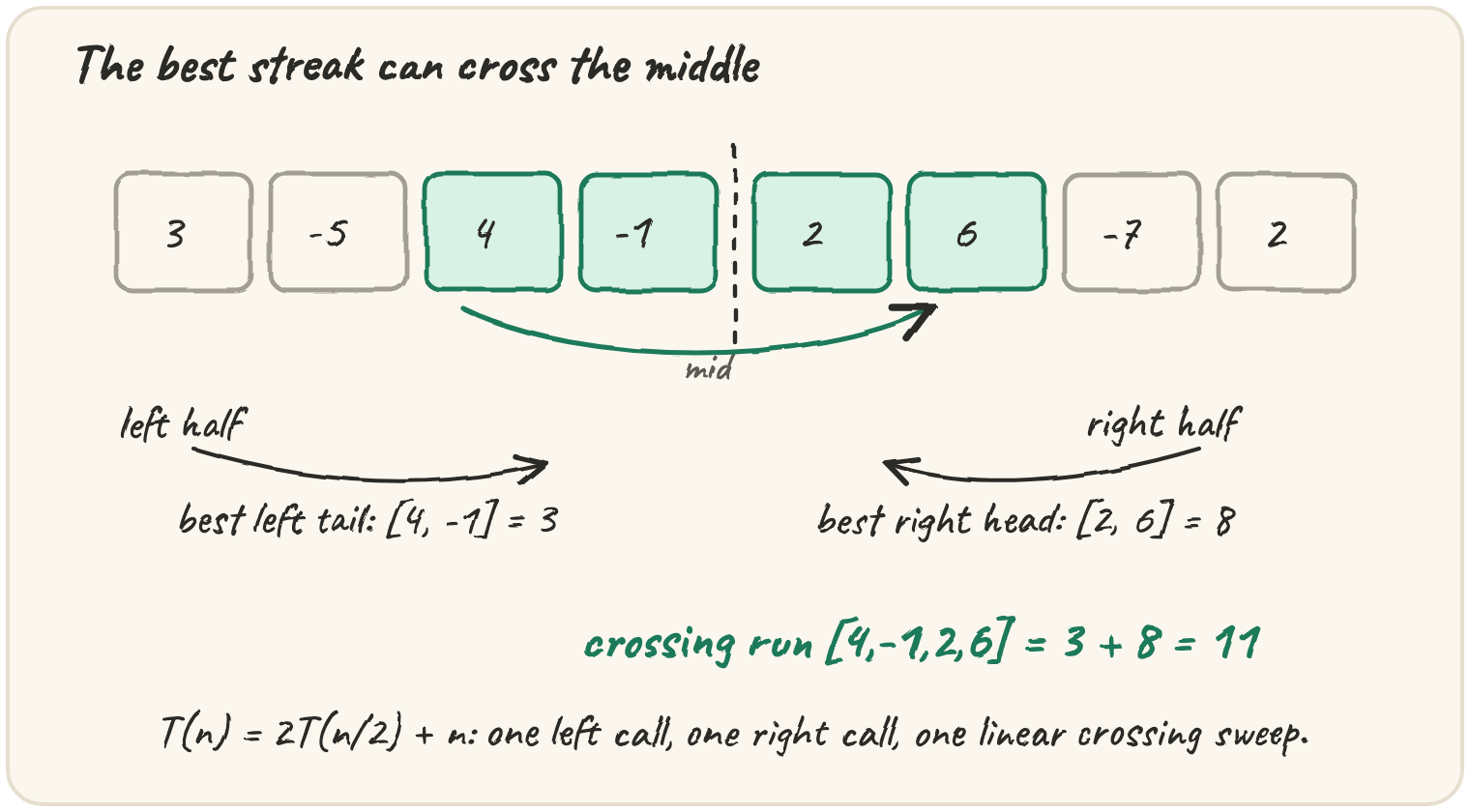
Checking every start and end is runs. Divide and conquer splits the days in half. The best streak is in one of three places:
- entirely in the left half, which the left recursive call finds;
- entirely in the right half, which the right call finds;
- crossing the middle: it ends somewhere in the left half's tail and starts somewhere in the right half's head.
The crossing case is the combine step, and it is linear: grow a run leftwards from the middle keeping the best sum, grow one rightwards the same way, and add the two. So , the merge sort recurrence, .
Here is the crossing case on its own. Step through the left sweep:
Before running the next one, work out what the crossing run is worth:
d = [3, -5, 4, -1, 2, 6, -7, 2]
mid = 4

total, best_left = 0, None
for i in range(mid - 1, -1, -1):
    total += d[i]
    best_left = total if best_left is None else max(best_left, total)

total, best_right = 0, None
for j in range(mid, len(d)):
    total += d[j]
    best_right = total if best_right is None else max(best_right, total)

print(best_left + best_right)Now watch your own divide and conquer run on all eight days. Each frame after a split shows the range being combined, the middle pointer, and the best crossing run in green. Change the deltas, or try an all-negative history:
Your best-streak search. The crossing run is the only new work each call does, and it is linear in the range.
Leave out the crossing case and the algorithm is still recursive, still fast, and wrong:
This should print 11, the streak 4, -1, 2, 6. It prints 6: with no crossing case, the only runs it can ever return are single days.
Halving the exponent: fast power
Divide and conquer also works on a single number. To compute , don't multiply n times. Split the exponent: when n is even, and when it is odd. One call on half the problem, constant combine: , .
mults = 0

def power(x, n):
    global mults
    if n == 0:
        return 1
    if n == 1:
        return x
    if n % 2 == 0:
        half = power(x, n // 2)
        mults += 1
        return half * half
    mults += 1
    return x * power(x, n - 1)

power(3, 1000)
print(mults)The same trick works on anything you can multiply associatively, including matrices. A graph's adjacency matrix raised to the power k counts the walks of exactly k hops between every pair of nodes, and fast power computes it with matrix products. That is the capstone exercise.
When dividing does not help
Divide and conquer is not free. Before reaching for it, write the recurrence:
- The combine is as expensive as the whole problem. Splitting a list to find its maximum gives , which is : no better than a loop, with recursion overhead on top.
- The pieces overlap. Naive Fibonacci splits
fib(n)intofib(n-1)andfib(n-2), which share almost everything. When subproblems repeat, you need a memo, which is dynamic programming from section 6, not divide and conquer. - A simpler scan exists. The best streak has a one-pass solution: keep the best run ending at today, and either extend it or start fresh. Divide and conquer is worth knowing here because its shape generalises to cases the scan cannot handle, like combining streak summaries from many servers.
Idioms & real-world patterns
Pass bounds, not slices
Every recursive function in this lesson takes lo and hi rather than slicing.
Slices copy, and a copy in the combine step can turn a +1 into a +n and change
the whole recurrence.
pow(x, n, mod) is fast power
Python's three-argument pow does exactly the squaring trick, keeping every
intermediate value below mod. pow(3, 10**18, 1_000_000_007) returns instantly.
⚡ Advanced — the same idea, other places
The fast Fourier transform multiplies polynomials in by splitting into even and odd coefficients. Strassen's method multiplies matrices with 7 half-size products instead of 8, giving . In each case, the win is one fewer recursive call, compounded over log n levels.
Quick practice
mults = 0

def power(x, n):
    global mults
    if n == 0:
        return 1
    if n == 1:
        return x
    if n % 2 == 0:
        half = power(x, n // 2)
        mults += 1
        return half * half
    mults += 1
    return x * power(x, n - 1)

print(power(2, 13), mults)2⁵ is 32. This prints 1, because halving odd exponents with no "and multiply by x once more" case throws away a factor of x at every odd level.
🎯 Your turn
Write best_streak(deltas): the largest total of any run of one or more
consecutive days. deltas is never empty. Use divide and conquer: left half, right
half, and the run that crosses the middle.
best_streak([3, -5, 4, -1, 2, 6, -7, 2])→11best_streak([-4, -2, -9])→-2, a streak must contain at least one day
Hint — write a helper on lo and hi. Its base case is one day. Its combine
is the best left tail plus the best right head, as in the trace above.
Then press ▶ Run, tap the Live App try chips, and hit ✓ Check.