
Rabin-Karp & Rolling Hashes
In short: Rabin-Karp fingerprints every window with a polynomial hash, so
comparing two windows is one number comparison instead of m character
comparisons. Sliding the window removes the leaving character's weight,
shifts, and adds the entering character, all in O(1), so the whole scan is
O(n + m) expected. A hash match is only a hint — two different windows can
collide — so every hit must be verified against the real characters before it
counts as a match.
From here on, the course builds Quarry, a small search-and-storage engine: the kind of program that sits under a log viewer, a code-search box or a document store. Each section adds one subsystem, and this one adds the text index. A user types a phrase, and Quarry says where it occurs in a pile of text without reading any character more often than it has to.
The first question is the obvious one. How do you find a pattern of length m
inside a text of length n?
The naive search, and where it wastes work
Line the pattern up at every start position and compare character by character until something differs:
On ordinary English the inner loop usually stops at the first character, so the
search is close to O(n). On repetitive text it is not. A thousand as and a
pattern of twenty as then a b make every alignment compare 21 characters
before failing, which is about n · m comparisons. Machine logs, DNA and padded
records are exactly that kind of repetitive.
text, pattern = "aaaaa", "aab"
compares = 0
for i in range(len(text) - len(pattern) + 1):
    for j in range(len(pattern)):
        compares += 1
        if text[i + j] != pattern[j]:
            break
print(compares)Compare numbers, not strings
Rabin and Karp's idea is to give every window a fingerprint, a single number
computed from its characters. Work out the pattern's fingerprint once. Then, at
each alignment, compare two numbers instead of m characters. Only when the
numbers agree do you look at the characters, to confirm.
That only pays off if two conditions hold:
- different strings usually get different fingerprints, and
- the next window's fingerprint can be found from the current one in O(1), without rereading the whole window.
A polynomial hash gives both. Treat the string as a number written in base B,
with each character's code as a digit, and keep only the remainder modulo M:
Horner's rule computes it left to right with one multiply and one add per character:
Step through the same loop on a three-letter word and watch h grow and wrap:
❓ Cross-question — "Why not just add the character codes?" Because a sum ignores order.
"cat"and"act"would collide, and so would every anagram. The powers ofBgive each position its own weight, the way the digits of 472 and 274 mean different amounts.
Rolling the window
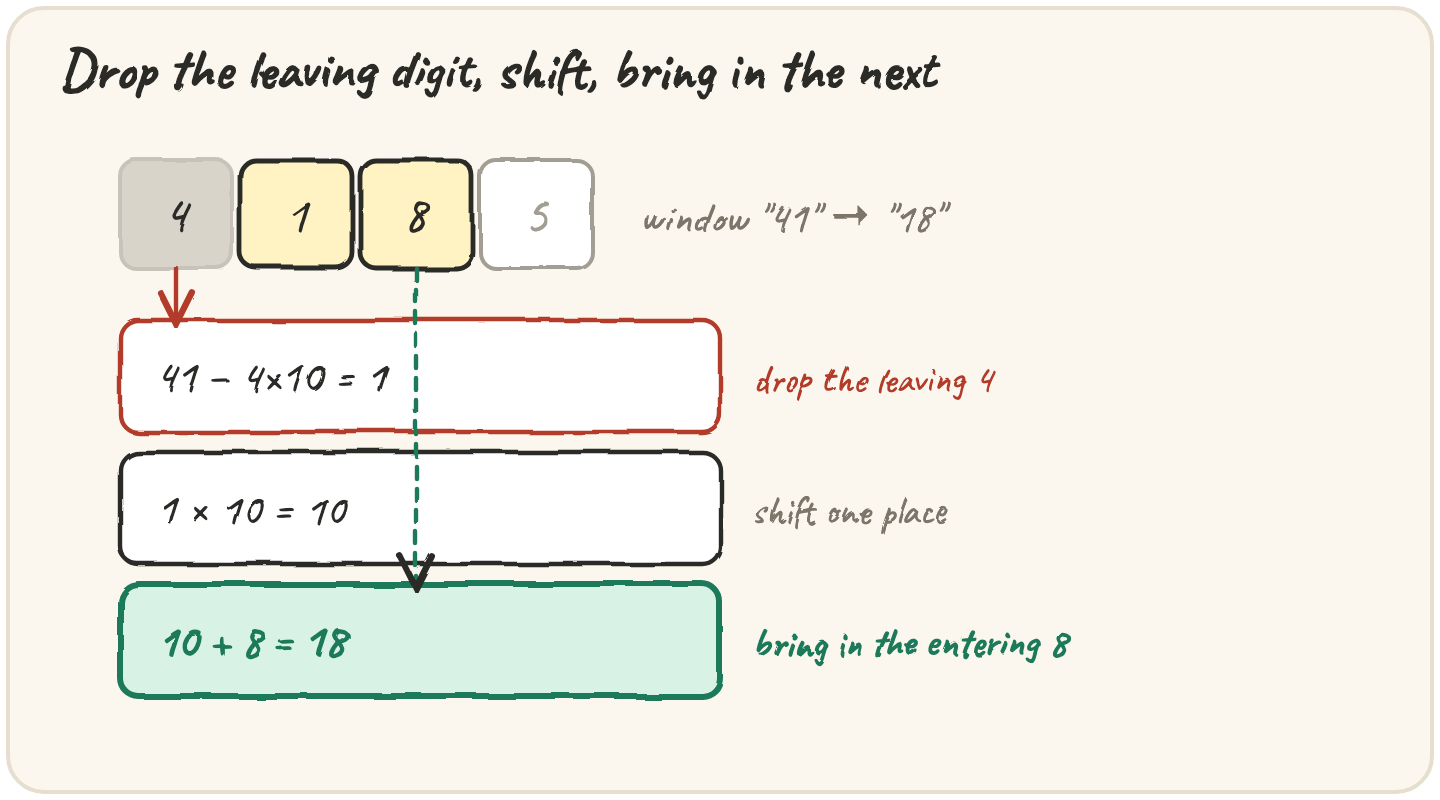
Here is the payoff. When the window slides one place right, one character leaves
at the front and one enters at the back. In base 10 with the window 41 about to
become 18:
- remove the leaving digit's contribution:
41 − 4·10 = 1 - shift everything one place left:
1 · 10 = 10 - add the entering digit:
10 + 8 = 18
The same three moves work on the remainder, because taking mod M after each
step never changes the final remainder:
B^{m-1} mod M is computed once, before the scan, so each slide costs O(1)
whatever the pattern's length.
Below, the text is a string of digits and the base is 10, so you can check every fingerprint in your head. The modulus is a deliberately tiny 7, which makes collisions common enough to see:
Each slide updates the fingerprint in O(1). Characters are compared only on a hash hit, and a hit can still be a false alarm.
The pattern 27 has fingerprint 6. The first window, 41, has 41 mod 7 = 6 too. That's a hash hit, so now the characters get compared. 10 cells. i at index 0.
pattern 27 → 27 mod 7 = 6
base, mod = 10, 7
h = 41 % mod                              # window "41"
h = ((h - 4 * base) * base + 8) % mod     # drop the 4, bring in the 8
print(h, 18 % mod)Rabin-Karp in full
Put the pieces together. Hash the pattern and the first window, then slide. On a hit, verify with a slice comparison:
pow(base, m - 1, mod) is Python's three-argument power. It reduces modulo mod
as it goes, so it never builds a huge number.
This version loses a match. Find why:
"abra" occurs at 0 and at 7, but this prints only [0]. The second one is the last window.
Now run your own. The code below redraws the window as it slides, marking hits
in green and false alarms in red. Change mod from 7 to 13, then to 101, and
watch the false alarms disappear. Then try a text of your own:
Your rolling hash, one slide per frame. Every frame costs O(1) work, and only a hit costs a character comparison.
Choosing the modulus
A false alarm costs one wasted verification. The danger is a modulus that makes false alarms systematic rather than rare. Watch what happens when the modulus shares a factor with the base:
With M = 256 = B, every power of B from B¹ up is 0 mod M, so only the
last character survives and every word ending in t collides. A modulus that
divides some power of the base throws information away the same way. Here is the
short number-theory note behind the usual choice:
- Pick a prime
Mthat doesn't divideB. ThenBhas an inverse modM, the powers ofBnever collapse to 0, and each position keeps its own weight. - Pick
Mlarge. For two fixed different strings, the chance that a random-ish hash makes them collide is roughly1/M. Overnwindows you expect aboutn/Mfalse alarms. - Pick
Blarger than the alphabet. WithB = 256, two different byte strings of the same length are different base-256 numbers before the modulus touches them. - Against an adversary, randomise. Someone who knows
BandMcan construct colliding strings. ChoosingBat random when Quarry starts, or keeping two hashes with different primes, defeats that. With two, a false alarm needs both to collide at once.
Quarry scans a million windows, and about n/M of them collide by accident. That's 1,000 false alarms with , one with , and 0.1 with , the first power of ten that gets below one. Real engines use a prime near , or two primes at once, which makes a false alarm about a one-in-a-billion event per window.
❓ Cross-question — "Python has
hash(). Why not use that?" It's fine inside one run for a dict, but it can't roll: you'd rehash the whole window every time. On top of that, string hashing is salted per process, so the same text hashes differently tomorrow. A fingerprint that Quarry writes to disk must be one you define yourself.
An interview question: shared runs of events
Two services each log a sequence of event codes, one character per event. Does
any run of k consecutive events appear in both logs?
Comparing every run in one log with every run in the other is O(n · m · k). Fingerprint every window of the first log into a set, then roll through the second and check membership. A hit still needs verifying, so keep the start positions next to each fingerprint:
That is O(n + m) expected time. The build and boss exercises below use the same set-of-fingerprints move.
What it costs
| naive | Rabin-Karp | |
|---|---|---|
| preprocessing | none | O(m) to hash the pattern |
| each alignment | up to O(m) | O(1) update, plus O(m) on a hit |
| whole scan, typical | O(n) | O(n + m) expected |
| whole scan, worst case | O(n · m) | O(n · m) if nearly every window really matches |
| extra memory | O(1) | O(1) |
The worst case survives because real matches still have to be verified. Search
"aaa" in a million as and there are nearly a million genuine hits to confirm.
What Rabin-Karp removes is the cost of the windows that don't match, and those
are almost all of them. The next lesson removes the worst case entirely, with no
hashing at all.
Idioms & real-world patterns
pow(base, m - 1, mod)for the leaving character's weight. Compute it once.- Hash, then verify. Equal fingerprints mean probably equal strings, never certainly. Always confirm before reporting a match.
- A dict from fingerprint to start positions turns "does any window repeat?" into one pass.
- Where rolling hashes live: duplicate-file and plagiarism detection, the
chunk boundaries in backup tools and
rsync, repeated-substring searches, and anywhere many patterns of the same length are searched at once (hash them all into one set).
Quick practice
def h(s, base, mod):
    v = 0
    for ch in s:
        v = (v * base + ord(ch)) % mod
    return v

print(h("cab", 10, 97), h("bac", 10, 97))"27" doesn't occur anywhere in "6207318", but this reports hits at [0, 1] — both are false alarms under the tiny modulus 7, reported as real because nothing verifies them.
🎯 Your turn
Build hash_scan(text, pattern, mod), Quarry's fingerprint scanner. Use base
256 and character codes, h(s) = (ord(s₀)·256^(m−1) + … + ord(s_{m−1})) mod mod,
and roll the window across text. Return a dict:
"matches": the start index of every real occurrence, in order (overlaps count)"false_hits": how many windows had the pattern's hash but different characters
If the pattern is empty or longer than the text, return
{"matches": [], "false_hits": 0}.
hash_scan("abracadabra", "abra", 1_000_003)→{"matches": [0, 7], "false_hits": 0}- with a tiny modulus like
3, some windows will collide, so"false_hits"goes up.
Then press ▶ Run, tap the Live App try chips, and hit ✓ Check.